Duke Lee
Nov 12,2025
I Got the Google UX Design Certificate. Now What?
I’ll never forget a pivotal moment in my career. Our design team had spent two grueling months moving from discovery and user research to high-fidelity implementation. Finally, the day of the big reveal arrived.
We gathered all the key stakeholders to present our findings, the user pain points we’d uncovered, and our roadmap for future collaboration. What was supposed to be a standard 60-minute review spiraled into a three-hour standoff.
The tension stemmed from a complete lack of alignment with the VP of Product. After rounds of heated debate, he slammed his hand on the table and spat out: "Fine, just do whatever design you think is best!" then stormed out of the room. The meeting didn't end; it died in a chilling silence. For weeks following, the product team fell into a state of "passive resistance", disengaged and stalling project progress.
Back at the office, our team held a post-mortem. On the surface, we were doing everything right: we were advocates for the user, our team was packed with senior talent, and many held Google UX Design certificates. We used the latest design tools and followed a rigorous, industry-standard process. Yet, we failed.
So, where was the disconnect? What was truly stopping us from driving the design forward?
Regardless of that VP’s management style, I also went ahead and earned my Google UX Design certificate this year. Through the Google UX curriculum, I realized that when shifting from a consumer-facing (C-end) mindset to a business (B-end) environment, "cognitive gaps" can directly stall a project's progress.
If you are in a product-driven organization, you might not have to align with as many people, or perhaps the PM handles the communication with other units. However, in a functional organization, there are inevitably many internal issues that must be resolved first. The probability of your design actually "landing" only increases once you have secured buy-in from the majority of stakeholders. (To determine your organization type, you can refer on how designers quickly align with goals under different structural frameworks.)
In this article, I want to share my reflections after earning the Google UX Design certificate. I’m well aware of the breadth and methodology this course offers for consumer-facing products. However, if the design field you are pursuing is business-oriented , where products are highly complex and prioritize "cost reduction and efficiency", the C-end focus of Google UX Design may only be the foundation.
I have synthesized the course content with my past B-end experience to provide you with a deeper level of "translation" and "upskilling" .
Article Structure
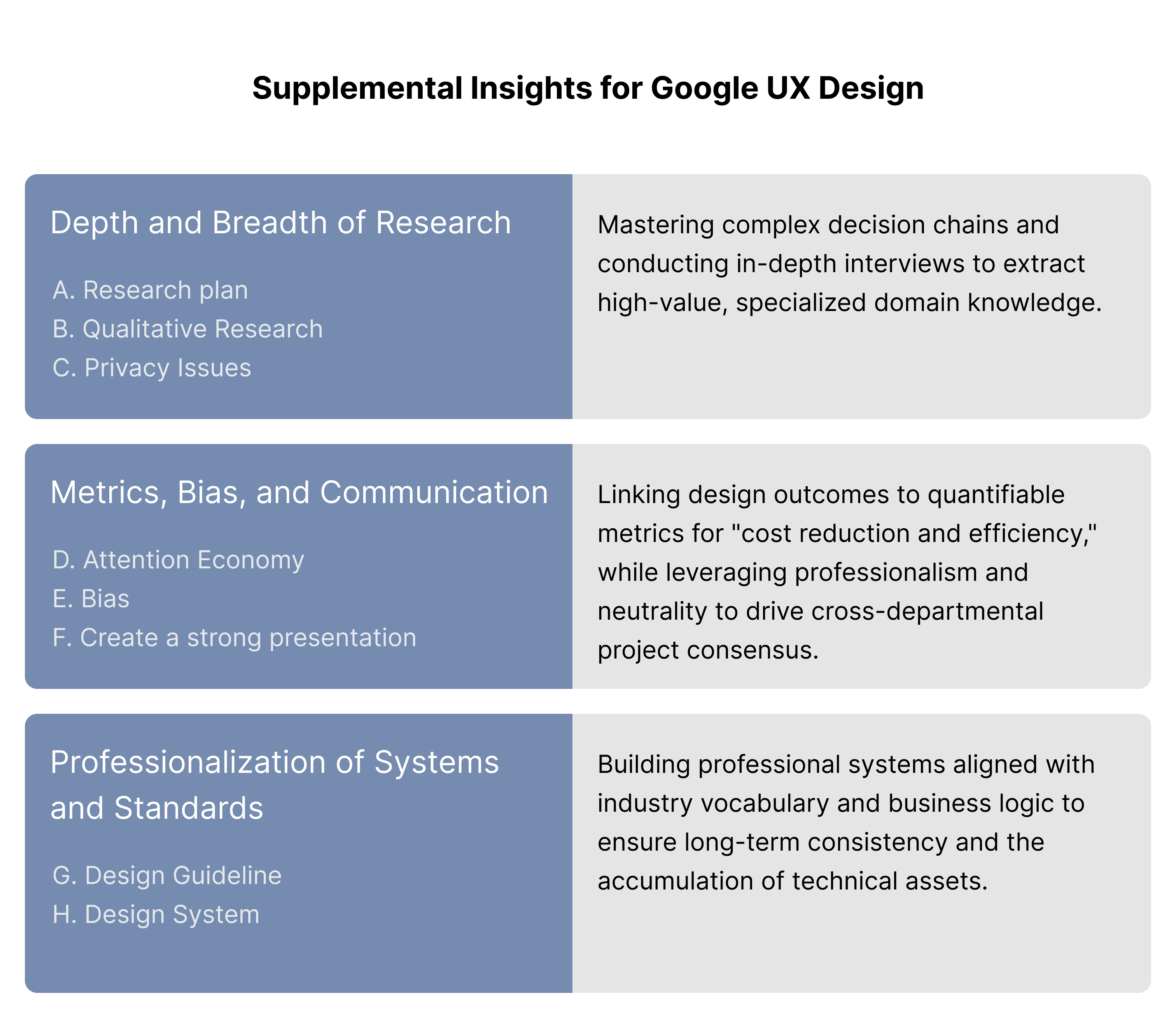
Depth and Breadth of Research
Metrics, Bias, and Communication
Professionalization of Systems and Standards
Reflections on Rare Issues in B2B
Becoming a B2B Designer
Conclusion - Don’t Let a Certificate Define Your Value
Note: This article provides supplementary insights based on specific chapters from the course; it is not intended to cover every single detail.
1.Depth and Breadth of Research
Research plan
We often say that for a B2B designer, the ability to identify stakeholders is crucial. Given the high complexity of the decision-making chain in the B2B industry, your research plan cannot focus solely on the end-user.
It must encompass direct users (e.g., employees operating the system), indirect users (e.g., managers who rely on the reports generated by the system), and, most importantly, the decision-makers (e.g., the Product VP or Department Managers who actually authorize the purchase). Much like B2B sales, finding the key C-suite clients and driving initiatives from the top-down is often far more effective than trying to push from the bottom-up.
B. Qualitative Research
If you’ve come across NN/g’s article "Why You Only Need to Test with 5 Users", your intuition when conducting qualitative research might be to invite 5–8 users for a study. However, in the B2B industry, the value of interviewing a single Subject Matter Expert (SME) often far outweighs that of 5–8 users who lack professional domain knowledge.
We say that In-depth Interviews (IDI), which help us understand the "Why" behind corporate workflows, are far more critical than the superficial 'How' obtained through broader, surface-level research.
C. Privacy Issues
In the B2C world, after performing Data Anonymization, it is relatively easy to recruit users or observe data for research. However, for enterprises that take Privacy Issues extremely seriously, whenever a client is willing to sign an NDA and allow you to conduct research, I literally say ten prayers, it is a stroke of incredible luck.
Because research is often highly restricted in a B2B environment, a designer's "observation skills" and "sensitivity" are paramount. In these cases, your primary research sources typically boil down to two key methods: Contextual Inquiry and Shadowing.
2.Metrics, Bias, and Communication
D. Attention Economy
B2C products typically chase Time-on-Site, focusing on conversion rates and user engagement. However, for a B2B designer, the core metric is cost reduction and efficiency. Therefore, the focus shifts toward Time-on-Task and Error Rate. The goal is to help users complete their tasks "quickly" and "accurately" so they can get out and move on, rather than encouraging them to linger and enjoy the process.
E. Bias
The course frequently emphasizes the importance of avoiding Bias, which is especially critical for B2B designers, particularly the avoidance of Expert Bias. Many designers underestimate the importance of Domain Knowledge and mistakenly apply their daily life experiences to professional B2B scenarios. For instance, applying a routine online shopping flow to a complex financial approval system often leads to overlooking critical compliance and industry-specific 'hard' regulations.
F. Create a strong presentation
This section is a must-learn, and I highly recommend spending extra time mastering it. As an enterprise grows, your design presentations are no longer just "show-and-tell"; they become leverage for project momentum. In the B2B industry, a single design project impacts a vast array of stakeholders and departments across complex hierarchies.
A comprehensive presentation that successfully translates design language into business value is the primary factor in whether a project moves forward, and whether you can secure the resources to implement it. Designers must possess high EQ and strong communication skills to effectively link design decisions to business goals.
3.Professionalization of Systems and Standards
G. Design Guideline
We often hear about open-source general guidelines like Google Material Design or Apple’s Human Interface Guidelines (HIG). While they provide a solid foundation, they aren't necessarily applicable to highly specialized B2B industries.
B2B designers must focus on a sector's unique Operational Vocabulary. For instance, industries such as finance, healthcare, and logistics have their own established conventions—and even operational terms and workflows that carry legal implications. In these fields, being "professional" and "aligned" with industry-specific habits is far more important than being "universal".
H. Design System
In the B2B industry, the objective is typically "cost reduction and efficiency", a goal that is equally vital internally. When development costs rise, profit margins inevitably shrink. Therefore, a well-executed Design System is more than just a library; it operates at the level of corporate strategy.
B2B products are highly modular, feature-rich, and often need to span multiple platforms. A robust design system ensures long-term consistency across product lines and reduces technical debt, fundamentally achieving the core business goal of reducing costs while increasing efficiency.
4.Reflections on Rare Issues in B2B
Google UX Design Course Supplement
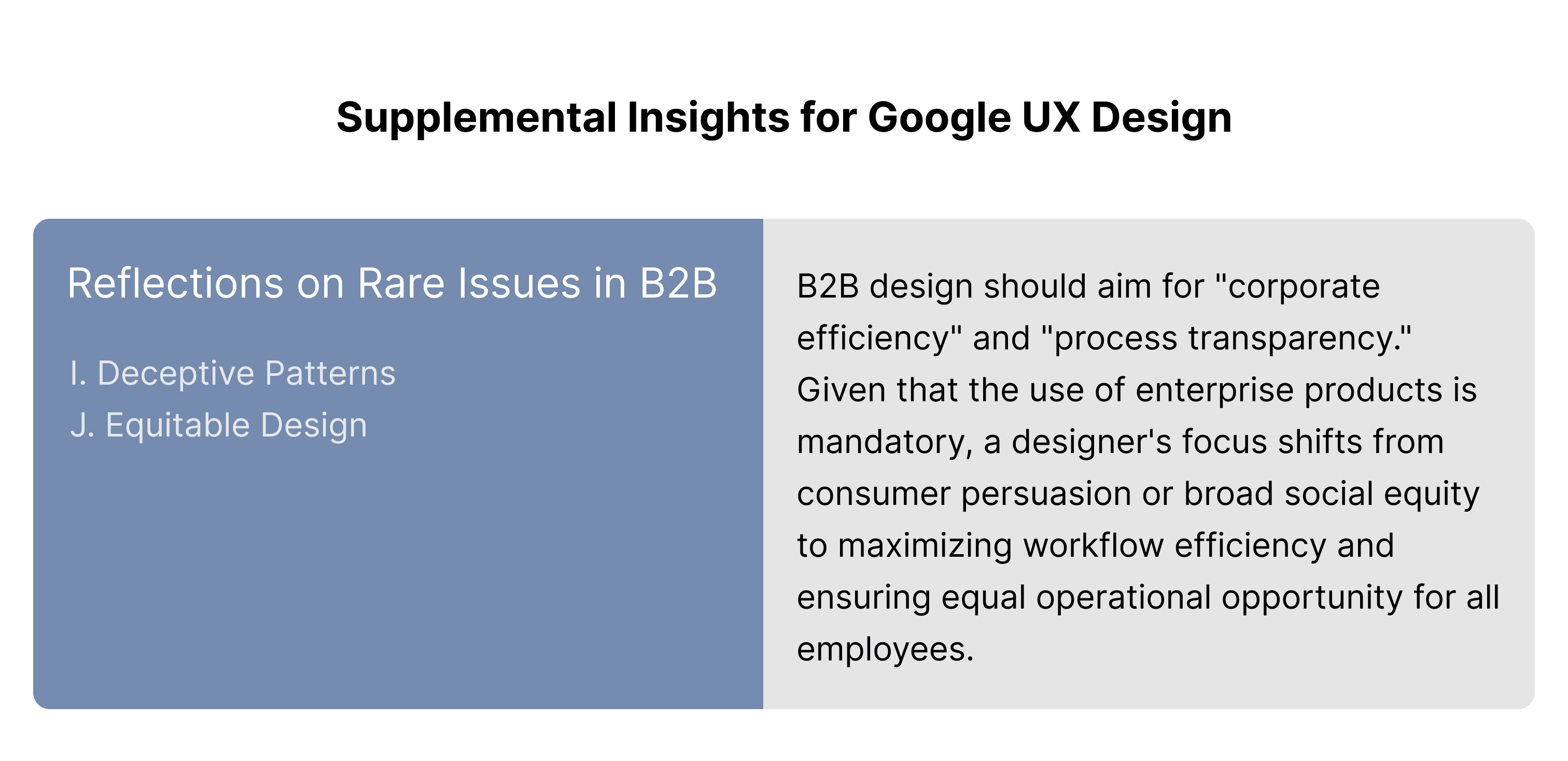
In the Google UX Design course, you will frequently hear about avoiding Deceptive Patterns and practicing Equitable Design. While there is high demand for these two topics in the B2C sector, their importance and how they are interpreted differ significantly within the B2B industry.
I. Deceptive Patterns
The issue of Deceptive Patterns is inherently at odds with the B2B goal of "cost reduction and efficiency." B2B products demand efficiency, clarity, and predictability. A designer's work is centered on transparency, affordance, and process simplification, rather than using design tricks to induce irrational behavior from the user.
J. Equitable Design
In B2B organizations, the designer’s mission is usually to ensure that every employee required to use the product can do so efficiently. I emphasize "required" because once the boss or high-level management purchases a product, employees often have no choice but to use it.
In this scenario, the focus shifts more toward Accessibility. Based on my past experience shadowing workers on factory floors, I’ve observed a common trend: many factories now employ a large number of migrant workers. In such cases, ensuring that users from diverse cultural and linguistic backgrounds can complete their tasks smoothly, achieving a universal "equality of work efficiency", becomes paramount.
5.Becoming a B2B Designer
Becoming a B2B Designer
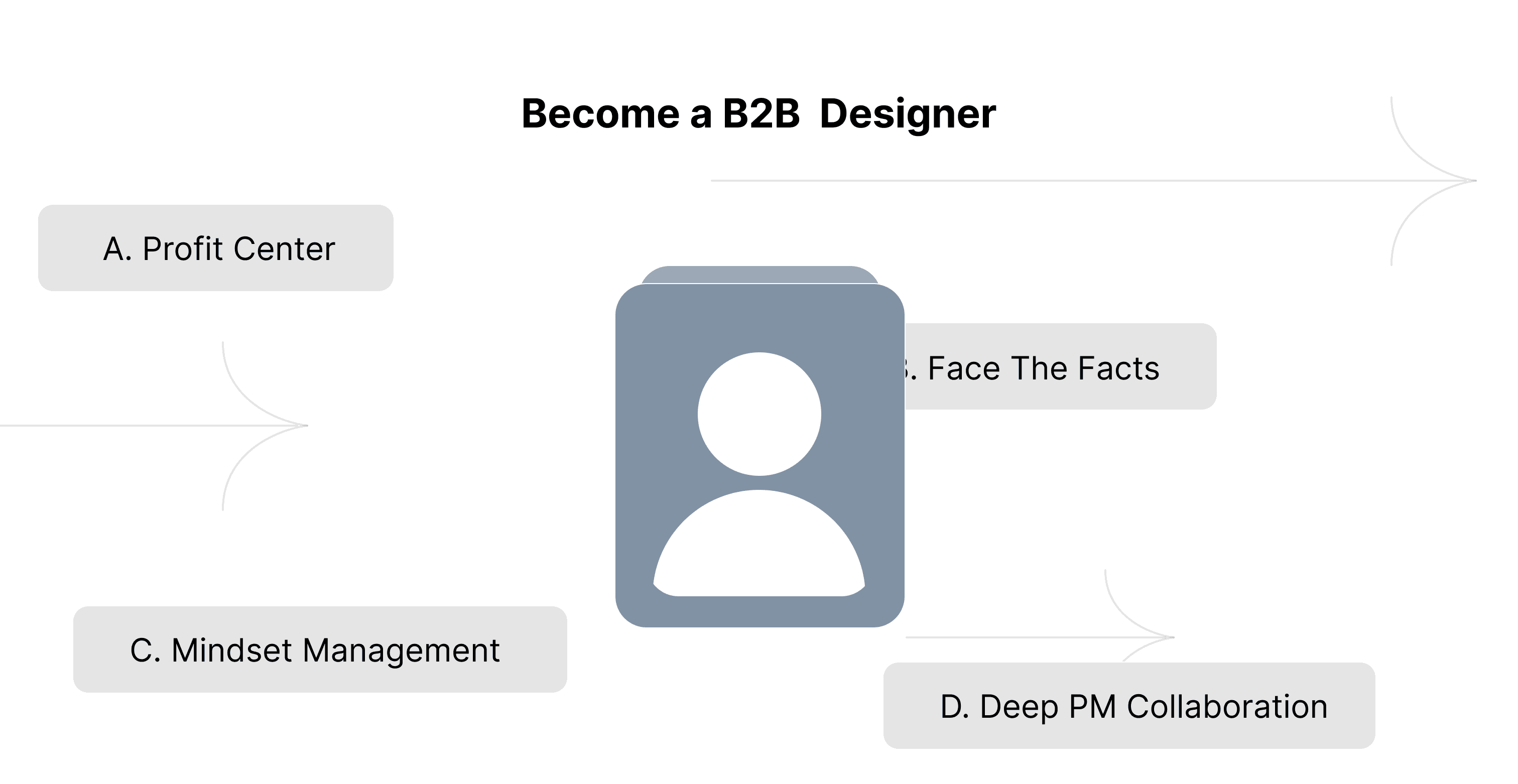
In the B2B industry, to transition from a UX executor to a true UX designer, it is crucial to link your design outcomes directly to "business success." This is the shortcut to increasing a designer's influence, and there are four key pillars to navigating this path.
A. Profit Center
Whether in B2B or B2C, we often see the value of designers being undermined, either by being assigned unreasonable tasks or by being the last to receive resources. To elevate a designer's value, linking design to ROI (Return on Investment) is essential. Designers must learn to speak the language of finance, describing the benefits of design changes in terms of cost savings or increased efficiency.
For example: "This process optimization reduced the error rate by 5%, which is equivalent to saving 90 hours per year for 200 employees, ultimately cutting 10 million in labor costs for the company."
Avoid purely descriptive feedback like "this interface is more user-friendly" or "it looks better", results that cannot be quantified. Instead, focus on translating metrics like Time-on-Task and Error Rate into actual economic value. This is the only way to persuade a company to allocate resources and move a project forward.
B. Face The Facts
I spent a long time brainstorming this title. If you have any better ideas, I’d love to hear them!
When we join an organization, the enterprise or department is often already grappling with Technical Debt and Legacy Systems. In such environments, a designer cannot afford to live only within the "ideal" of a Figma file.
Instead, you must spend significant time collaborating with engineers to understand existing technical and architectural constraints, whether APIs can be integrated, or even if the hardware at the client’s site can support your design.
We all know that a "perfect design" doesn't exist; design is an ongoing process of iterative optimization. As a B2B designer, your role is to find the most optimal solution, the sweet spot where technical feasibility meets user experience.
C. Mindset Management
In the past, designers leaned heavily on psychological tricks, but what I want to discuss here is not the tactics, but the user psychology itself. When B2B users are "required" to adopt a new system rather than choosing it proactively, resistance is a natural byproduct.
Designers cannot focus solely on the product; we must also design the "Adoption Journey." We have to incorporate the user’s discomfort and resistance to change into our project plans. To ensure a smooth launch, elements like In-app Tutorials, User Training, and even Customer Success strategies are critical. Only through continuous monitoring and optimization can we ensure that employees transition to the new system smoothly and painlessly.
D. Deep PM Collaboration
B2B Product Managers operate quite differently from their B2C counterparts. In our organization, PMs often possess deep and critical domain knowledge. In this symbiotic relationship, the PM is responsible for defining the "What," while the designer is responsible for defining the "How."
The designer acts as the PM's translator, converting abstract, complex expertise or business logic into a clear, actionable experience. This division of labor makes our collaboration more professional and effective.
6.Conclusion - Don’t Let a Certificate Define Your Value
Looking back at that meeting, the core issue wasn’t whether our design was "good" or "beautiful." The problem was that we weren't speaking a language that everyone understood.
B2B products deal with complex corporate workflows and the business goal of "cost reduction and efficiency." Unlike B2C, which pursues personalized experiences, a B2B designer acts as a mediator for complex systems and a translator of information. As mentioned earlier, we must possess high EQ and communication skills to maintain a dynamic balance between technical constraints, business logic, and end-user needs.
There is a distinct difference between having a "certificate" and being a "professional."
Let’s be honest: the Google UX Design certificate is merely a stepping stone; it provides a common language for design fundamentals. However, the true value of a professional B2B designer lies in using empathy to solve corporate pain points and deliver tangible ROI, especially when dealing with abstract, complex, and highly restricted environments.
Never let past experiences or achievements limit your growth. Only through continuous learning and upskilling can you secure your place in the high-stakes battlefield of B2B design.
Note: Following this year's update, the course now includes a module on AI in UX. If you completed the certification previously, I highly recommend revisiting it to stay current with these new industry standards.
I know you probably have many thoughts after reading this, I’d love to hear them.
Got a design idea? I'm always ready to dive in with you.